

Lactate supplements are the latest hype. Lactate gels appeared in the Tour de France peloton, “exogenous lactate” is a growth category in sports nutrition, and the underlying science genuinely has moved — lactate is a fuel and a signalling molecule, not a waste product (if you want to read an excellent review from Prof George Brooks, the world leading authority on lactate metabolism, click here). The question I wanted answered was narrower and more practical: does ingesting it make anyone faster?
So I ran a systematic review and meta-analysis. I did not do it with the final aim to submit it to a peer reviewed journal to get a publication out of it. If I did that, you would be probably reading this in two years after going through the pain of: writing the paper, formatting it to a journal, submitting it, going around the houses with reviewers and editors, eventually get it accepted and published. I just wanted a quick answer for me and I am sharing this on my blog. So, despite the scientific approach to the process (systematic review and meta-analysis) this is not peer reviewed and therefore you need to consider this blog for what it is. For this work I used Claude Science (Anthropic) with Opus 5 as the LLM.
What follows is both the answer and an honest account of how it was produced — including where an AI research agent hit its limits, where it made mistakes, and where my judgement as the researcher had to override it. That second part matters as much as the first, because the tooling is now good enough that the interesting question is no longer “can it do the analysis” but “where does the human have to stay in the loop.”
The short summary
Across eleven randomised crossover trials (119 participants, 1994–2024), the pooled effect of exogenous lactate on exercise performance was g = 0.13 (95% CI −0.05 to 0.31, p = 0.13). That interval includes zero. Splitting by training status gave athletes g = 0.28 and non-athletes g = 0.07, but the formal test of that difference was null (p = 0.46).
Lactate is unambiguously a usable fuel and a genuine signalling molecule. It is not, on current evidence, an ergogenic aid.
Those two statements sit together comfortably. The marketing story runs: lactate is fuel, therefore ingesting lactate helps performance. The evidence supports the first half and has not yet delivered the second, but considering the paucity of studies, hopefully more studies will be conducted to see if this really works.
How the review was built
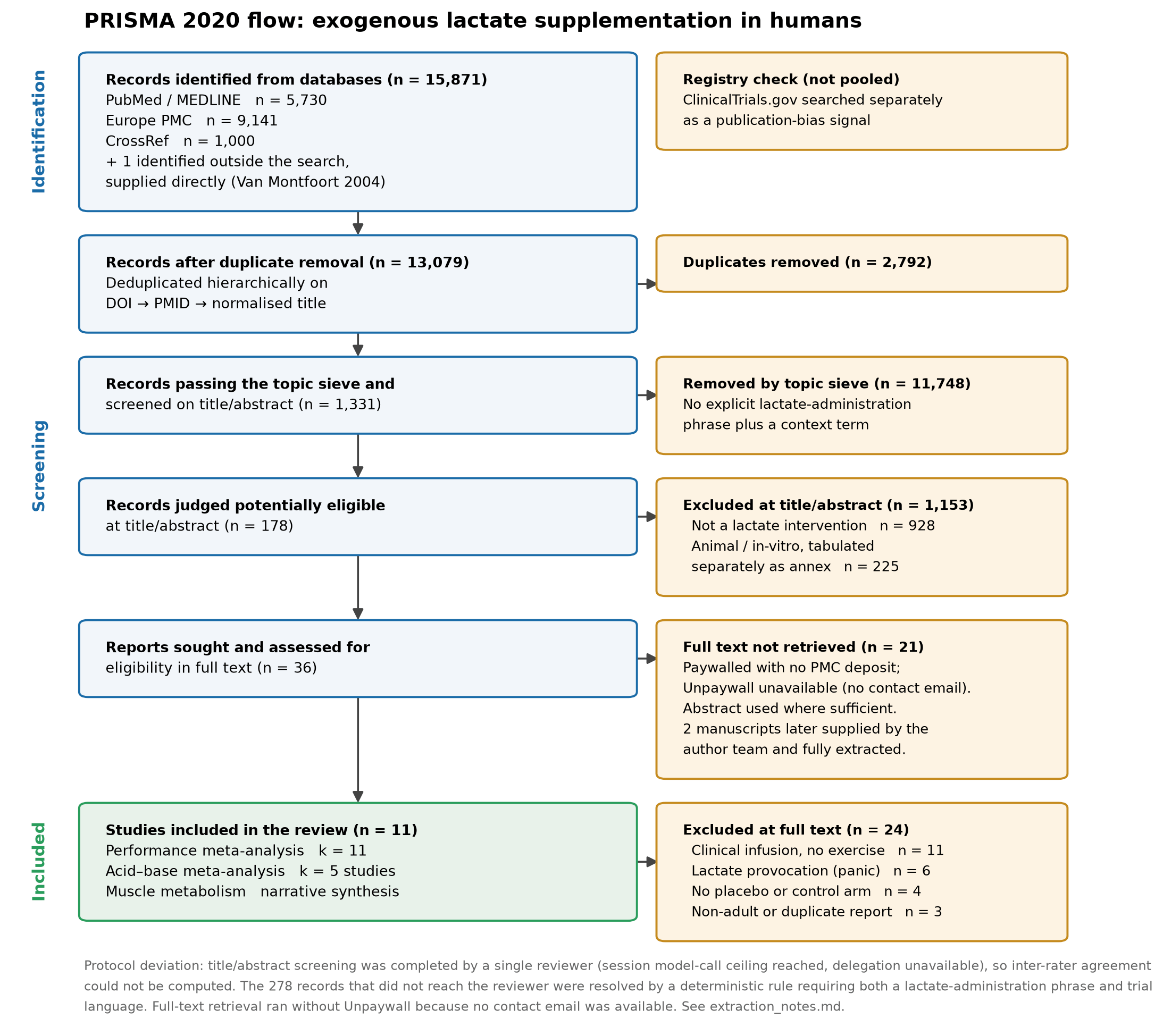
I searched PubMed/MEDLINE, Europe PMC and CrossRef, retrieving 15,871 records that deduplicated to 13,079. A topic sieve narrowed this to 1,331 records for title/abstract screening, 36 full texts were sought, and 11 trials met criteria. Ten came out of the search; the eleventh — Van Montfoort et al. (2004) — the search missed entirely, and it only entered the review because I went looking for it by hand afterwards. More on that below.
Where I had to intervene: the screening ceiling
The protocol specified duplicate independent screening with a Cohen’s κ agreement statistic — standard practice, and what any reviewer would expect. Partway through, the agent hit a hard capacity limit: it had screened 1,053 of 1,331 abstracts and could not run the second reviewer pass. Crucially, it stopped and asked rather than quietly proceeding, laying out three options: enable parallel processing so the full protocol could run, accept single-reviewer screening as a stated deviation, or narrow scope to the core identified trial set.
I chose to narrow scope. That was a judgement call with a real cost, and it is worth being explicit about the trade: the review is honest about the trials it found, but the 278-record tail got a keyword rule rather than reviewer judgement, and this review has no inter-rater agreement statistic. Every included trial was independently identified by more than one search route, which is reassuring about the core set — but it is not a substitute for duplicate screening, and I would not want that glossed. As it turned out, the search had a bigger problem than the screening did.
This is the first place the human-in-the-loop mattered. An agent optimising for a finished-looking deliverable would have reported “systematic review” and moved on. The useful behaviour was surfacing the constraint as a decision for me to own.
Where I had to intervene again: the search missed a trial
After the first version of this post went up I obtained two full manuscripts I had not been able to get during the review. One was Morris et al. (2011), which I had previously worked from the abstract. The other turned out not to be in the review at all: Van Montfoort et al. (2004), a 15-runner double-blind crossover comparing sodium lactate, sodium bicarbonate, sodium citrate and sodium chloride on time to exhaustion. It is indexed in PubMed. It is exactly on topic. The search did not surface it.
That is worth being blunt about, because it is a different kind of failure from the screening ceiling. The screening problem was a known limitation I flagged and worked around. This was a silent miss: a query built around lactate-supplementation phrasing did not match a paper framed as a comparison of four alkalinising salts, and nothing in the pipeline registered that anything was absent. Recall failures do not announce themselves — there is no error message for a paper you never saw. With one confirmed miss out of eleven included trials, the honest position is that I do not know the true recall of this search, and neither does any automated pipeline that has not been checked against a hand-built reference set.
Adding it did not change the conclusion — the pooled performance estimate moved from 0.13 to 0.13, which is the least interesting possible outcome and also the most reassuring one. What it did change is the acid–base picture, the small-study asymmetry test, and my confidence in the corpus being complete.
What the trials show
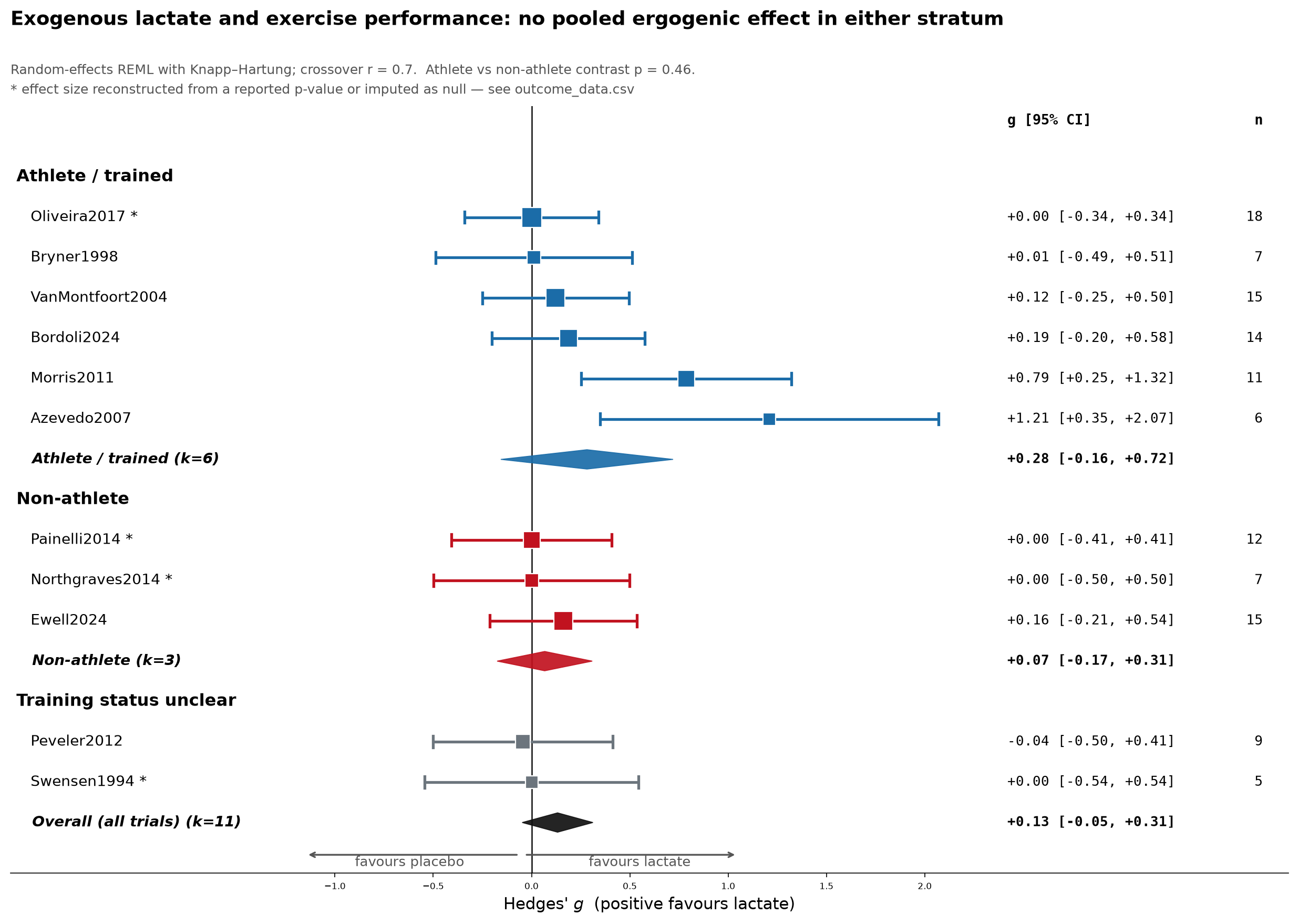
The athlete stratum’s point estimate is four times the non-athlete one, which is exactly the sort of contrast that becomes “works better in trained athletes” in a product brochure. It should not. The interval spans zero generously, the moderator test is null, and the stratum is carried by its two strongest single results — both of which have a problem:
- Azevedo et al. (2007) (g = 1.21, n = 6) — the largest effect in the review. It compared a lactate-polymer multi-ingredient drink against an isocaloric fructose/glucose sports drink. Active comparator, multiple active ingredients: any difference cannot be attributed to lactate only really.
- Morris et al. (2011) (g = 0.79, n = 11) — this one changed since the first version of this post, and it is worth explaining how. Originally I could not obtain the full text, so I reconstructed the effect from the reported p-value and rated the trial high risk of bias for everything it did not describe. The full manuscript then turned up. It is a properly conducted double-blind randomised crossover with an aspartame placebo in matched capsules and at least 48 h between trials, so most of that bias rating was my ignorance rather than the trial’s design, and I have downgraded it to some concerns. But the means it contains (168 ± 31 vs 137 ± 41 s) give a larger effect than my reconstruction did, and the acknowledgements name the supplier: Sport Specifics Inc., the company behind SportLegs — the same firm that supplied and funded Ewell et al. (2024). The strongest signal in the trained stratum is a manufacturer-supplied product.
Drop Azevedo and the pooled estimate falls to 0.11. Drop Morris and it falls to 0.09 — Morris is now the single most influential trial in the analysis, which is an uncomfortable place for a sponsor-supplied product to sit. The athlete stratum’s I² of 59% is itself the tell that these trials are not measuring one common effect.
The caveat that matters most
Four of the eleven performance effects are null-imputed. Those trials reported their performance outcome as “non-significant” and gave no means or standard deviations, so there was nothing to extract. Entering them as zero is conservative about direction but it fakes precision — a non-significant result is compatible with a range of effects, not specifically with zero.
This is why the primary model shows I² ≈ 0% and a reassuringly tight interval. Refit on the seven effects that were actually reported, and the interval widens roughly twofold: g = 0.24 (95% CI −0.09 to 0.57). That is the honest number. I put it in the report next to the primary estimate rather than in a supplementary appendix, because reading only the primary model would leave you more confident than the evidence warrants.

The mechanistic crux: no mediator big enough
If lactate salts worked the way bicarbonate does, the acid–base shift would be the mechanism. Pooled across five trials, that effect is g = 0.72 (95% CI −0.53 to 1.98) — but that number is doing something misleading, and the newly added trial is why. Van Montfoort et al. gave 400 mg/kg of sodium lactate, the largest dose in the corpus, and measured a very large bicarbonate shift (g = 3.36). Its placebo, though, was iso-osmolar sodium chloride, which lowers bicarbonate on its own — so part of that gap is the placebo moving down rather than lactate moving up, and the SD behind it is model-derived from a seven-person blood subsample. Excluding it, the pooled acid–base effect is g = 0.43 (95% CI −0.20 to 1.06). Both are on the figure. Neither interval excludes zero.
The most informative trial here is Oliveira et al. (2017), the only one that included a bicarbonate positive control. Calcium lactate moved bicarbonate essentially not at all (g = −0.04), in the same participants, against a comparator known to work. A dose that fails to shift blood chemistry also fails to shift performance. There is no mediator here large enough to produce an ergogenic effect.
Where lactate genuinely does something
The metabolic literature is much stronger than the performance literature, and it deserves separating out.
It is oxidised fast. In a tracer study, ¹³CO₂ production from orally ingested ¹³C-lactate rose faster and more completely than from any other labelled substrate tested, doubling between 45 and 60 minutes of exercise while every other substrate peaked at or after 75 minutes. The breath kinetics are too fast for a liver-first gluconeogenic route, which points at working muscle as the site of most of that oxidation.
It is antilipolytic, and substantially so. A sodium-lactate infusion raising plasma lactate to 2.7 mmol/L cut postabsorptive lipolysis by about 30% — palmitate flux 84 ± 32 versus 120 ± 35 µmol/min, mean difference −36 (95% CI −58 to −14), p = 0.003 — with lower free fatty acid concentrations. Insulin sensitivity itself was unchanged. This is a clean, well-controlled effect, plausibly via the GPR81 receptor in adipose tissue.
Note the direction, though. Suppressing fat oxidation during prolonged exercise shifts reliance toward finite carbohydrate stores. For endurance work that is arguably the wrong way round — which makes a substrate-utilisation trial more interesting than yet another time trial, and raises the real possibility that exogenous lactate impairs long-duration performance (but we definitively need experimental trials to test this hypothesis).
Quality of the evidence
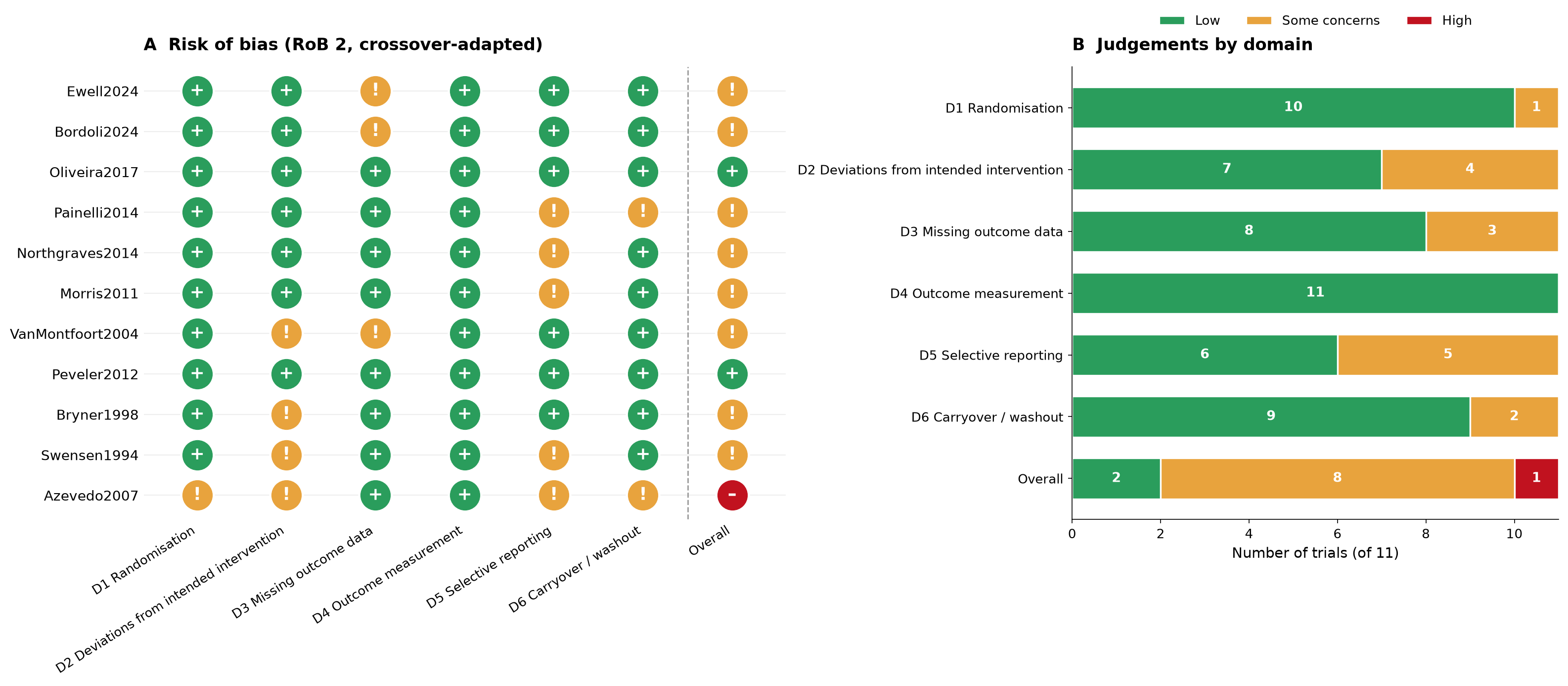
Nine of eleven trials carry some concerns or high risk of bias. Selective reporting is the weakest domain — which is the same defect that produced the four null-imputed effects, since a trial reporting “no significant difference” without numbers is simultaneously a reporting problem and a data-extraction problem. Median sample size across the whole corpus is 11. Egger’s test now crosses the conventional threshold for small-study asymmetry (p = 0.049, previously 0.074) — at k = 11 I would still read that as descriptive rather than as a bias test, but it moved in the direction you would expect when a genuinely missed trial is added.
On GRADE domains I would call the performance evidence low certainty: downgraded for risk of bias, imprecision, and indirectness across heterogeneous forms, doses and comparators.
The chemistry: read the label
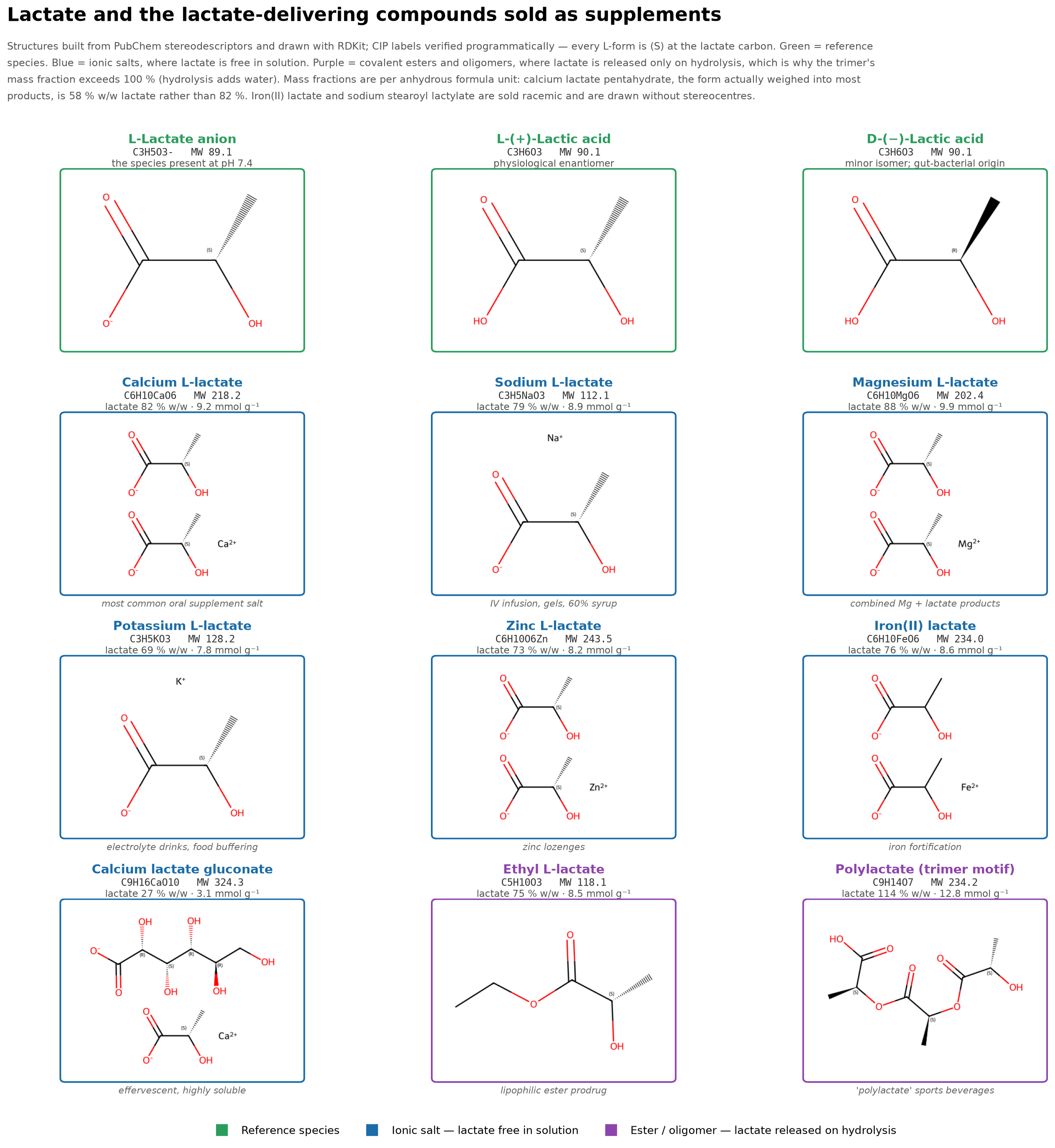
The last piece of work conducted with the AI agent was structural — what is actually in these products. I had the agent build every structure from PubChem stereodescriptors and verify each stereocentre computationally.
Where the agent got it wrong
This figure is where the most instructive error happened, and I want to describe it precisely because it is the kind of mistake that is easy to ship.
The first rendered version labelled every L-form with the CIP descriptor belonging to its mirror image. Physiological lactate is L-(S); the panels said (R). The cause was subtle: the SMILES strings had been written by hand, and reordering the substituents around a stereocentre while keeping the original chirality tag silently inverts the molecule. No error, no warning — a chemically valid structure of the wrong enantiomer.
It was caught by looking at the rendered figure and noticing the annotations contradicted the compound names. Every SMILES was then rebuilt from PubChem’s own stereodescriptors and re-verified on three axes: successful parsing, per-centre CIP label matching the name, and unchanged molecular formula. That third check is what confirmed the fix touched stereochemistry only, so the mass fractions computed earlier remained valid.
An agent that renders a figure and moves on ships the wrong enantiomer. Checking the output against what it claims to show is not optional.
There is a related point about why the error mattered scientifically rather than just cosmetically: several marketed lactate salts are sold as racemates. Iron(II) lactate and sodium stearoyl lactylate, among others, are DL- mixtures — meaning half the delivered lactate is the D-isomer, which in humans is largely of gut-bacterial origin and metabolised far more slowly. In the corrected figure those compounds are deliberately drawn without stereocentres, so the graphic does not imply an enantiomeric purity the products do not have.
Hydration state changes the dose by a quarter
| Form | Lactate % w/w | mmol lactate/g |
|---|---|---|
| Magnesium L-lactate | 88.0 | 9.9 |
| Calcium L-lactate (anhydrous) | 81.6 | 9.2 |
| Sodium L-lactate | 79.5 | 8.9 |
| Iron(II) lactate (racemic) | 76.1 | 8.6 |
| Ethyl L-lactate | 75.4 | 8.5 |
| Potassium L-lactate | 69.5 | 7.8 |
| Calcium L-lactate pentahydrate | 57.8 | 6.5 |
| Sodium stearoyl lactylate (racemic) | 39.5 | 4.4 |
| Calcium lactate gluconate | 27.5 | 3.1 |
Calcium lactate pentahydrate is the form actually weighed into most oral products, and it is 57.8% lactate by mass — not the 81.6% of the anhydrous salt. A trial reporting “500 mg/kg calcium lactate” therefore delivers materially different lactate depending on which it used, and papers frequently do not say. The counter-ion sets its own ceiling: calcium lactate at 500 mg/kg/day also delivers roughly 92 mg/kg/day of calcium.
Across the corpus of literature analysed, gastrointestinal tolerability — not lactate pharmacology — was the binding constraint. In Swensen et al. (1994), GI efflux at polylactate concentrations of 2.5% or above forced the drink down to 0.75%, meaning the tolerable dose may sit below any effective one: a dose-ceiling confound rather than simply low power. In Bordoli et al. (2024), overt GI side effects in the lactate arm likely compromised blinding.
What I take from this
For athletes and coaches. There is no good evidence lactate supplements improve performance, trained or untrained. The trials that look most favourable are the ones with an active comparator, compromised blinding, or a manufacturer in the acknowledgements. The single result I would build a follow-up study on is Ewell et al. (2024): oral lactate changed nothing about VO₂peak, ventilatory threshold or work rate at lactate threshold, but sustained work rate in a 20-minute functional threshold test was about 3.5% higher (204 vs 197 W). One modest effect on one outcome in fifteen people is a hypothesis, not a finding — and it is worth knowing that the supplement and the funding both came from the manufacturer. It points somewhere specific, which is different from being persuasive.
For researchers. The gaps are unusually well-defined. No trial has tested a form and dose that reliably produces the acid–base shift while remaining tolerable — the effective dose and the tolerability ceiling have not been shown to overlap. No trial has stratified L- versus DL- form, despite many marketed products being racemic. And given how substantial the antilipolytic effect is, a trial powered on substrate utilisation during prolonged exercise would tell us more than another time trial. For sure we need larger sample sizes.
On working this way
A few observations from doing a full systematic review with an AI agent as the analytical engine.
The mechanical work compresses enormously. Corpus assembly, deduplication across three databases, effect-size derivation under crossover assumptions, the sensitivity suite, RoB coding, and five publication-grade figures — that is weeks of work, and it ran in a session.
The errors are not where you expect. Nothing went wrong in the meta-analytic mathematics. What went wrong was a DOI parser harvesting identifiers from reference lists rather than article metadata, corrupting 1,285 records; and hand-written chemistry silently inverting stereochemistry. Also, some of the references were pulled in incorrectly. All were plumbing failures that produced confident, plausible, wrong output — the failure mode that peer review sometimes is worst at catching.
The human contribution was mostly refusal. Refusing to let single-reviewer screening be described as a full protocol. Refusing to supply a fabricated contact email to unblock a resolver. Refusing to accept a stereochemistry figure that looked right. Refusing to report the tight primary interval without the imputation-corrected one beside it. None of that is analytical labour — it is deciding what an honest version of the claim looks like, which remains the researcher’s job.
What earned trust was the agent stopping. The single most useful behaviour across the whole project was hitting the screening ceiling and asking me how to proceed, with the trade-offs of each option spelled out, instead of producing something that looked complete. Every protocol deviation in this review is written into the methods, footnoted on the PRISMA diagram, and listed in a companion document ordered by how much each should change your reading. That is the standard I would want, and it is achievable — but it has to be asked for.
The trials themselves: what was given, how much, for how long
Below is every trial in the review. Two things stand out once they are laid side by side. Brand was recoverable for most trials — difficult to verify the salt hydration state or enantiomeric composition of what was swallowed. And the supplier column has a pattern in it. Sport Specifics Inc. — the SportLegs manufacturer — supplied the product in three of the eleven trials, including the two that produced the strongest results, and funded one of them outright.
And only one trial used chronic loading. Oliveira et al. (2017) gave 500 mg/kg/day in four divided doses across five consecutive days. Every other trial was a single acute dose or feeding during exercise. Any claim you read about “lactate loading” rests on that one trial — which was null in its outcomes.
| Study | n | Status | Lactate form | Brand / supplier | Dose as reported | Supplementation duration | Comparator |
|---|---|---|---|---|---|---|---|
| Ewell et al. 2024 | 15 | non_athlete | Ca lactate + Mg lactate + vitamin D3 (capsules) | SportLegs (Sport Specifics Inc., Longmont, CO, USA) | 1 capsule per 22.7 kg body mass (manufacturer guideline); 372 mg lactate/capsule | Single acute dose | Organic rice starch placebo, visually identical |
| Bordoli et al. 2024 | 14 | athlete | Calcium lactate in opaque gelatine capsules | Special Ingredients Ltd. (Chesterfield, UK) | 147 mg/kg body mass calcium lactate = 120 mg/kg lactate | Single acute dose, ingested over 5–10 min | Flour placebo in matched capsules |
| Oliveira et al. 2017 | 18 | athlete | Calcium lactate | Not reported | 500 mg/kg BM/day as 4 × 125 mg/kg doses | CHRONIC — 5 consecutive days | Placebo + sodium bicarbonate positive control (same 500 mg/kg/d) |
| Painelli et al. 2014 | 12 | non_athlete | Calcium lactate | Not reported | High dose 300 mg/kg BM; low dose 150 mg/kg BM | Single acute dose | Placebo |
| Northgraves et al. 2014 | 7 | non_athlete | Lactate supplement (salt not specified) | Not reported | 1115 mg absolute lactate (not body-mass scaled) | Single acute dose | Plain flour placebo + NaHCO3 300 mg/kg arm + NaCl placebo |
| Peveler & Palmer 2012 | 9 | unclear | Magnesium lactate dihydrate + calcium lactate monohydrate | Not named (commercial product; abstract refers to ‘manufacturers of supplements’) | Not reported in abstract | Single acute dose | Placebo |
| Morris et al. 2011 | 11 | athlete | Calcium lactate | Not named; product supplied by Sport Specifics Inc. | 120 mg/kg body mass lactate | Single acute dose | Aspartame placebo in matched capsules + no-treatment control |
| Azevedo et al. 2007 | 6 | athlete | Lactate-polymer multi-ingredient drink (lactate polymer + fructose + glucose + glucose polymer) | CytoMax (containing PolyLactate); leading sports drink as comparator | Beverage consumed before and during exercise (tracer study) | Pre-exercise + during 90 min continuous exercise | Isocaloric fructose + glucose sports drink (ACTIVE comparator) |
| Bryner et al. 1998 | 7 | athlete | 2% lactate solution, ± 8% carbohydrate | Not reported | 2% lactate beverage consumed every 20 min during exercise | Consumed DURING exercise, every 20 min to exhaustion | Placebo, 8% CHO, and 8% CHO + 2% lactate arms |
| Swensen et al. 1994 | 5 | unclear | Polylactate (amino acid/lactate salt) + glucose polymer | Not named (‘as supplied by the manufacturer’) | 0.3 g CHO/kg BM every 20 min as 7% solution; 6.25 g GP + 0.75 g PL per 100 mL | Consumed DURING exercise, every 20 min to exhaustion | Isocaloric pure glucose polymer solution |
| Van Montfoort et al. 2004 | 15 | athlete | Sodium lactate (reagent grade, gelatin capsules) | None — laboratory salt, not a commercial product | 400 mg/kg body mass sodium lactate | Single acute dose | Sodium chloride, iso-osmolar (plus NaHCO3 and Na-citrate arms) |
Why the dose column cannot be read straight down
The corpus reports dose against three incompatible bases. Bordoli et al. specify 147 mg/kg of calcium lactate and convert it to 120 mg/kg of lactate; recomputing that from the anhydrous formula (81.63% lactate w/w) returns 120.0 mg/kg, which confirms both their arithmetic and that they used the anhydrous basis. Oliveira et al. and Painelli et al. report salt mass without stating hydration state, so delivered lactate is either about 82% of the printed figure (anhydrous) or about 58% (pentahydrate) — the papers do not say which. Ewell et al. report lactate mass, at 19 mg/kg: roughly one sixth of Bordoli’s dose, and the lowest in the review by a wide margin.
Two trials were dose-limited by the gut rather than by design. Swensen et al. had to cut polylactate from 2.5% to 0.75% because higher concentrations caused severe gastrointestinal efflux — meaning the tolerable dose may sit below any effective one. Bordoli et al. reported overt GI symptoms in the lactate arm, which probably unblinded it.
In conclusion
There is still a lot of work needed to really understand if lactate supplementation has positive effects on performance (and define on what type of performance). Most of all, it is still difficult to determine the appropriate dosage and formulation. Considering the hype of recent months, I hope more independent studies will be conducted to answer all those questions.
References
All eleven trials included in the review, in APA 7th edition. These were generated from retrieved PubMed citation metadata rather than transcribed by hand — which is how I caught that four of my own internal study labels had been named after the wrong author in the initial data scraping.
- Azevedo, J. L., Tietz, E., Two-Feathers, T., Paull, J., & Chapman, K. (2007). Lactate, fructose and glucose oxidation profiles in sports drinks and the effect on exercise performance. PLOS ONE, 2(9), e927. https://doi.org/10.1371/journal.pone.0000927
- Bordoli, C., Varley, I., Sharpe, G. R., Johnson, M. A., & Hennis, P. J. (2024). Effects of oral lactate supplementation on acid-base balance and prolonged high-intensity interval cycling performance. Journal of Functional Morphology and Kinesiology, 9(3), 139. https://doi.org/10.3390/jfmk9030139
- Bryner, R. W., Hornsby, W. G., Chetlin, R., Ullrich, I. H., & Yeater, R. A. (1998). Effect of lactate consumption on exercise performance. The Journal of Sports Medicine and Physical Fitness, 38(2), 116–123.
- Ewell, T. R., Bomar, M. C., Brown, D. M., Brown, R. L., Kwarteng, B. S., Thomson, D. P., & Bell, C. (2024). The influence of acute oral lactate supplementation on responses to cycle ergometer exercise: A randomized, crossover pilot clinical trial. Nutrients, 16(16), 2624. https://doi.org/10.3390/nu16162624
- Morris, D. M., Shafer, R. S., Fairbrother, K. R., & Woodall, M. W. (2011). Effects of lactate consumption on blood bicarbonate levels and performance during high-intensity exercise. International Journal of Sport Nutrition and Exercise Metabolism, 21(4), 311–317. https://doi.org/10.1123/ijsnem.21.4.311
- Northgraves, M. J., Peart, D. J., Jordan, C. A., & Vince, R. V. (2014). Effect of lactate supplementation and sodium bicarbonate on 40-km cycling time trial performance. Journal of Strength and Conditioning Research, 28(1), 273–280. https://doi.org/10.1519/JSC.0b013e3182986a4c
- Oliveira, L. F., de Salles Painelli, V., Nemezio, K., Gonçalves, L. S., Yamaguchi, G., Saunders, B., Gualano, B., & Artioli, G. G. (2017). Chronic lactate supplementation does not improve blood buffering capacity and repeated high-intensity exercise. Scandinavian Journal of Medicine & Science in Sports, 27(11), 1231–1239. https://doi.org/10.1111/sms.12792
- Painelli, V. de S., da Silva, R. P., de Oliveira, O. M., de Oliveira, L. F., Benatti, F. B., Rabelo, T., Guilherme, J. P., Lancha, A. H., & Artioli, G. G. (2014). The effects of two different doses of calcium lactate on blood pH, bicarbonate, and repeated high-intensity exercise performance. International Journal of Sport Nutrition and Exercise Metabolism, 24(3), 286–295. https://doi.org/10.1123/ijsnem.2013-0191
- Peveler, W. W., & Palmer, T. G. (2012). Effect of magnesium lactate dihydrate and calcium lactate monohydrate on 20-km cycling time trial performance. Journal of Strength and Conditioning Research, 26(4), 1149–1153. https://doi.org/10.1519/JSC.0b013e31822dcd7f
- Swensen, T., Crater, G., Bassett, D. R., & Howley, E. T. (1994). Adding polylactate to a glucose polymer solution does not improve endurance. International Journal of Sports Medicine, 15(7), 430–434. https://doi.org/10.1055/s-2007-1021083
- Van Montfoort, M. C. E., Van Dieren, L., Hopkins, W. G., & Shearman, J. P. (2004). Effects of ingestion of bicarbonate, citrate, lactate, and chloride on sprint running. Medicine & Science in Sports & Exercise, 36(7), 1239–1243. https://doi.org/10.1249/01.mss.0000132378.73975.25
Analysis in Python (pandas, RDKit, matplotlib) and R (metafor).
This is a research synthesis, not clinical or nutritional advice and it is not peer reviewed. Lactate salts carry sodium, calcium or potassium loads that matter for anyone with renal, cardiac or electrolyte conditions, and the doses used in these trials caused gastrointestinal intolerance in some participants. Decisions about supplementation for a specific person belong with a qualified clinician or sports dietitian who has the full picture.
You must be logged in to post a comment.