

Romania hosted the 11th edition of the IHF Women’s U18 (Youth) World Championship from 29 July to 9 August, and by the time the final whistle blew in Pitești, the tournament’s biggest story wasn’t the champion. Spain retained their title with a 26-23 win over a Montenegro side appearing in its first-ever final, but it was Egypt’s run to the semi-finals that will be remembered longest. As someone who has spent years looking at long-term athlete development systems, Egypt’s performance here is a case study worth unpacking in detail — both for what happened on court and for what it says about the pipeline that produced it.
A historic run, match by match
Egypt entered Romania 2026 off the back of a sixth consecutive African Women’s Youth Championship title, but nobody expected what followed. In the preliminary round they opened with a 27-24 win over Croatia, runners-up at the W17 EHF EURO 2025, then beat France by the same 27-24 scoreline before completing the group. In the main round they edged South Korea 28-27 in a match they trailed 6-1 early on, before closing on an 8-1 run to steal it in the final seconds, then beat a Denmark side that had won gold in three of the previous ten editions, 23-22.
That put Egypt through to the quarter-finals unbeaten in five, where they met the People’s Republic of China — themselves one of the tournament’s surprise packages — and won a thriller 30-29, with goalkeeper Jaydaa Salama producing what IHF’s own report called “the save of the match” to deny China’s final attack. Six wins from six. Since the championship’s inception in 2006, only South Korea had ever reached the semi-finals as a non-European nation; Egypt became the second, and the first African or Arab team in the competition’s history to do so.
The run ended agonisingly. Spain, the only other team with a perfect record, beat Egypt 27-26 in the semi-final — a one-goal margin against the eventual champions. In the third-place match, Denmark gained a measure of revenge for their main-round defeat, winning 23-19. Egypt finished fourth, but as former national team captain Hussein Zaki put it afterwards, the players “wrote a new chapter in the sporting history of Egypt, Africa, and the Arab world.”
The numbers behind the run
What stands out to me looking at the underlying statistics is that Egypt’s semi-final appearance wasn’t a fluke built on a soft draw — the data backs up a genuinely elite performance level across the board.
- Second-best attack in the entire 32-team field: heading into the semi-final, Egypt had scored 220 goals in six matches, an average of 36.67 per game — behind only the eventual champions.
- Leading scorers: right back Malak Aboyoussef finished as Egypt’s top scorer with 27 goals through the quarter-final stage, with Jowaireya Abdallah (26) and Sondos Abouelazaiem (24) close behind — all three ranked inside the tournament’s top 45 scorers from a field of several hundred outfield players.
- Zeina Kotb at the line: the line player scored 14 goals across the tournament, including 8 in the quarter-final alone against China, repeatedly finding space in a crowded area that’s typically the hardest position on the court to feed.
- Goalkeeping under pressure: Jaydaa Salama recorded 15 saves at a 43% save rate in the main-round win over Denmark, and 11 more saves in the quarter-final against China, including the tournament-defining stop in the closing seconds.
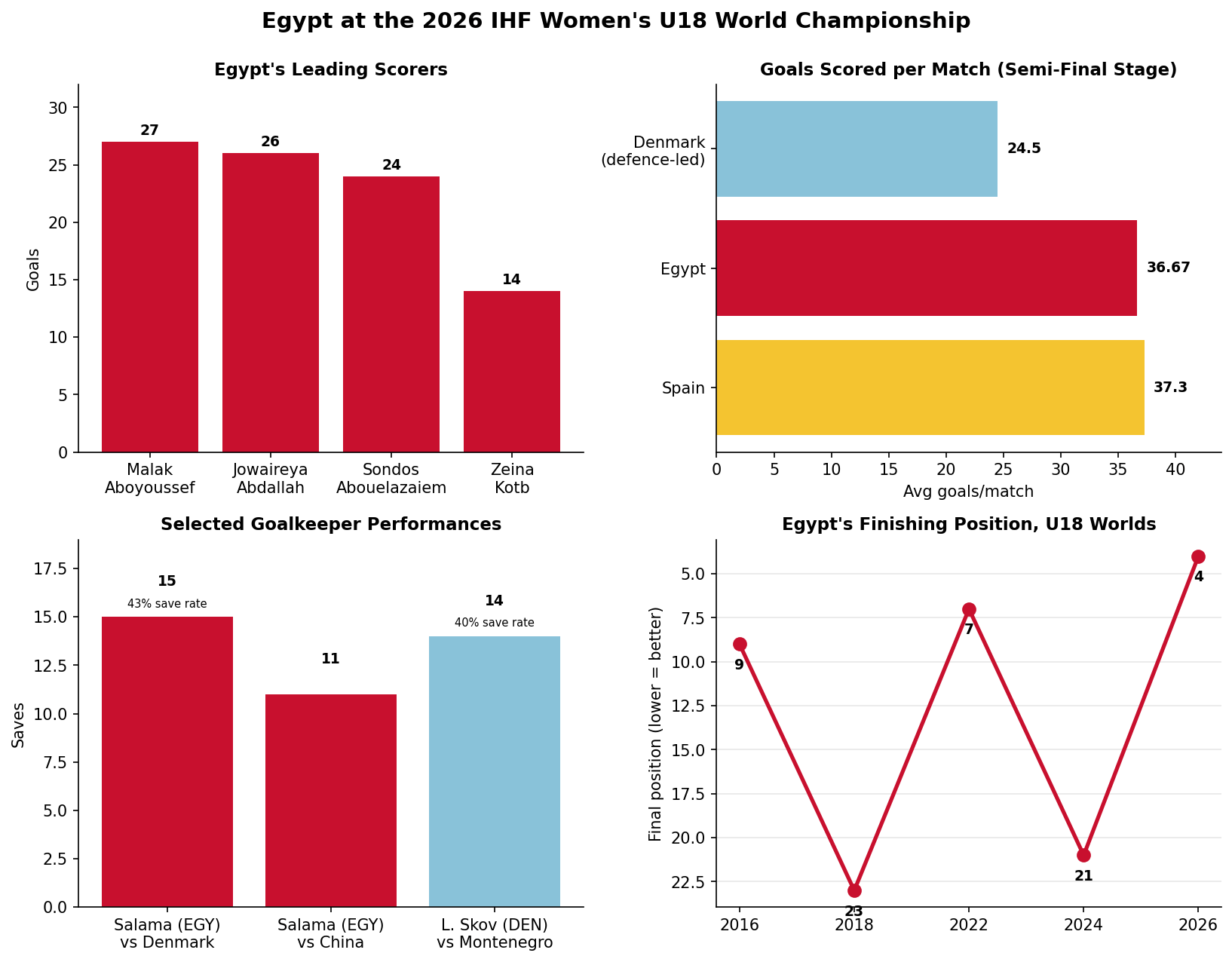
For context on what “second-best attack” means at this level: the tournament’s overall top scorer was Switzerland’s 16-year-old Lauryn Mierzwa with 71 goals, two clear of China’s Shuoyan Zhang on 69. Denmark had the joint-second-best defence in the competition (with France), conceding 124 goals across six matches, an average of 20.67 per game — a reminder that Denmark’s bronze medal was built on defensive solidity rather than scoring power, the opposite profile to Egypt’s attack-driven run. Best goalkeeper honours in the official All-Star Team went to Denmark’s Thilde Ladegaard Skov, who made 14 saves at 40% efficiency in the semi-final against Montenegro alone.
Two Egyptians in the official All-Star Team
Perhaps the clearest external validation of Egypt’s level came after the tournament closed, when the IHF announced its All-Star Team — the eight best players across all positions, drawn from six different nations. Despite finishing fourth, Egypt placed two players in that team: Malak Aboyoussef as the best right back, and Zeina Kotb as the best line player, alongside representatives from champions Spain, finalists Montenegro, Denmark and China. The full team:
- Goalkeeper: Thilde Ladegaard Skov (Denmark)
- Right wing: Erika Elena Vladu (Spain)
- Right back: Malak Aboyoussef (Egypt)
- Centre back: Andrea Dragnić (Montenegro)
- Left back: Shuoyan Zhang (China)
- Left wing: Lauryn Mierzwa (Switzerland) — tournament top scorer
- Line player: Zeina Kotb (Egypt)
- MVP: Elene Fresco Bastarrika (Spain)
Having two of eight All-Star selections from a team that didn’t reach the podium is a strong signal in itself — All-Star teams at IHF youth championships are overwhelmingly dominated by medallists, so recognition at this level for a fourth-place team points to individual performances that were genuinely among the best in the competition, not just good context around a good run.
Where this comes from: the Egyptian talent pipeline
None of this happened by accident, and it’s the part of the story I find most interesting professionally. Egyptian handball’s development model traces back to a blueprint established in the 1990s — commonly referred to as the Giants’ Project — championed by Hassan Moustafa, the long-serving president of the International Handball Federation and a former Egyptian federation official. The project’s core idea was to shift talent identification away from informal recruitment and toward physical scouting and scientific classification of youth sectors: identifying promising athletes early, profiling them against physical and technical benchmarks, and feeding them through a structured development pathway rather than leaving progression to chance.
That model was built primarily around the men’s programme, whose results speak for themselves — Egypt was the first non-European nation to win the U17 World Championship in 2019, took bronze at U19 the same year, and won silver at the 2025 U19 World Championship in Morocco. But the same institutional infrastructure — Ministry of Youth and Sports-funded academies, structured scouting systems, and investment in coaching — has increasingly fed the women’s pathway too. The senior women’s national team only re-formed in 2022 after a decade of inactivity, yet still reached their first-ever World Championship in 2025. The U18 team that just reached the semi-finals in Romania has now won six consecutive African Women’s Youth Championship titles (2015, 2017, 2019, 2022, 2023, 2025), a run of continental dominance that mirrors what the men’s pipeline achieved a generation earlier.
What’s notable is how recent and rapid the women’s improvement curve has been. Egypt’s U18 women finished 9th of 24 teams in 2016, dropped to 23rd of 24 in 2018, recovered to a quarter-final in 2022, and stayed in the preliminary round in 2024. The jump from a group-stage exit in 2024 to a semi-final in 2026 — with two All-Star selections attached — is a two-year leap that fits the profile of a system finally converting structural investment into results, rather than a one-off golden generation.
As a piece in the Middle East Observer put it in the days after the tournament, Egyptian football continues to dominate national attention and investment — the men’s senior team reached the World Cup Round of 16 this year, their best-ever finish — but Egypt’s broader sporting talent pool may be underexploited outside it. The comparison isn’t meant to diminish football, but it’s a fair point: a country that can produce a fourth-place finish and two All-Star selections at a world championship, in a sport that receives a fraction of football’s funding and media coverage, has a talent pipeline worth paying closer attention to.
Final standings and closing thought
Spain topped the podium as back-to-back champions — only the third team in the competition’s history to win consecutive titles, after Denmark (2006, 2012) and Russia (2016, 2018) — with Montenegro taking a maiden silver, Denmark bronze, and Egypt fourth. But rankings alone undersell what happened in Romania. A team that had never previously finished higher than seventh at this level beat two former champions (South Korea, Denmark) and two of the tournament’s other surprise packages (Croatia, China), fielded the tournament’s second-best attack, and had two players judged among the eight best in the competition. For a programme built on the same scouting and development philosophy that turned Egyptian men’s handball into a top-five world force, this looks less like a ceiling and more like a floor for what comes next.
All the statistics of the tournament are available here: https://www.ihf.info/sites/default/files/competitions/5fe80c31-eed8-4ffb-acbe-f773ae9dc81b/pdf/TOPSCORER.PDF?n=1786464834
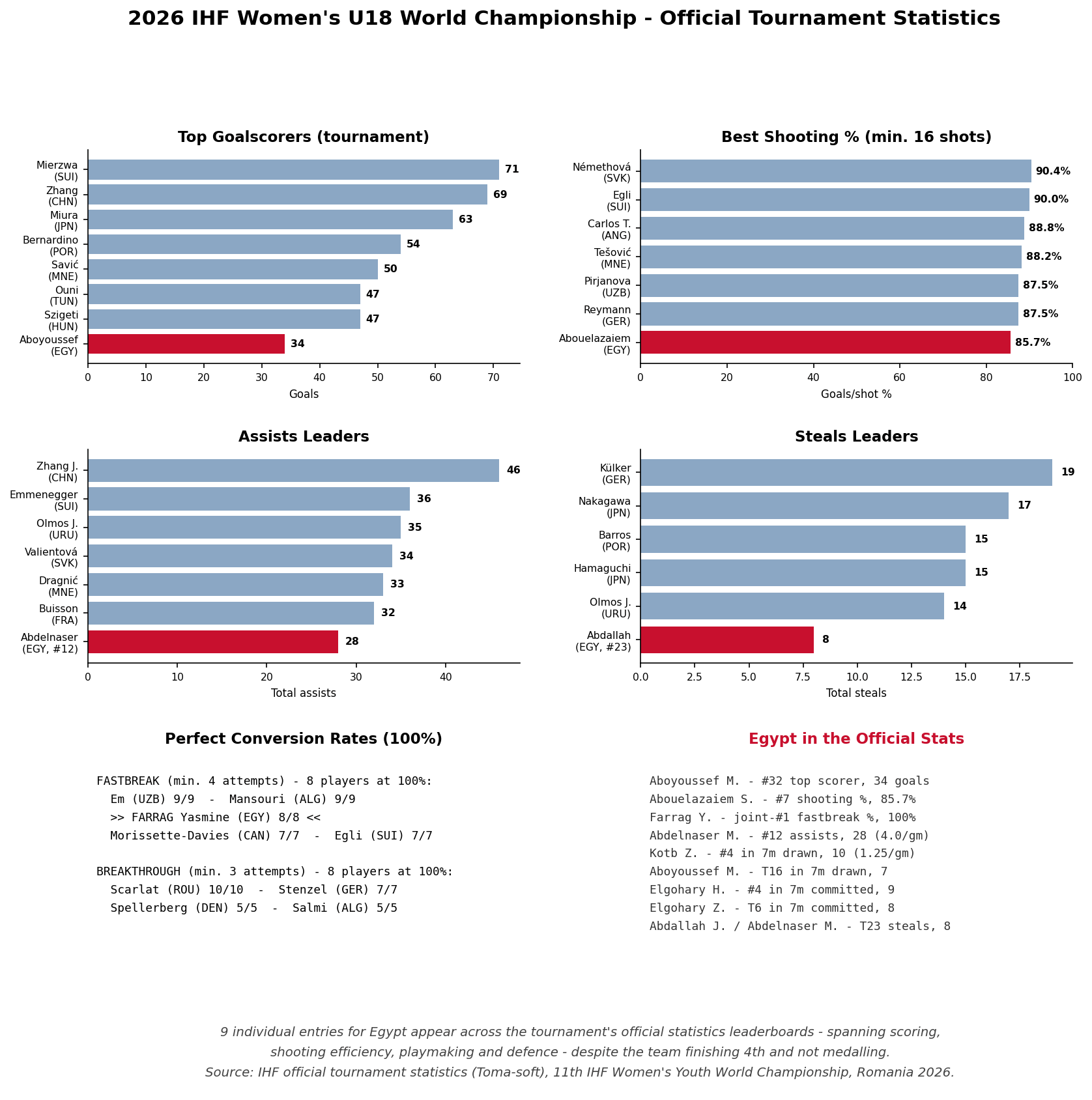
The last note is about spectators. Sadly most games are played in almost empty venues. This is a problem worldwide when the hosting team is not playing. Maybe something for another blog post.
Sources: International Handball Federation (ihf.info), Egyptian Handball Federation, Ahram Online, Arab News, Egyptian Streets, Egyptian Gazette, Wikipedia.
You must be logged in to post a comment.