Category: Strength Training

Using Force Platforms to characterise exercises


Strength and conditioning coaches and Physiotherapists write training and rehab programs choosing various exercises. The choice of exercises depends on many aspects:

– Goals of the programme

– Movement patterns that need to be improved

– Muscle activation patterns of the chosen exercises

– Force production during the execution of the exercises

– Characteristics of the athlete/the sport/ the rehab needs for which they are writing the programme

Pretty much we can say that everyone prescribes a series of exercises for a reason, or at least, to try to obtain a specific goal. Despite this process seems pretty straight forward, it is surprising to find out how many times rehab or training programs are not based on sound progressions. Most of the times such planning mistakes are due to the fact that Force-Time patterns and/or muscle activation patterns of the exercises are unknown. This leads many times to inappropriate choice of exercise and/or inappropriate choice of progression. This problem is particularly acute when the athlete performing the training exercises prescribed is someone trying to recover from injuries.

In this simple article I want to introduce some simple concepts and some examples of how to critically analyse some exercises analysing Force-Time characteristics and muscle activation.

I promise to present more exercises in the next articles in order to provide hopefully some useful information for strength and conditioning specialists and physiotherapists.

I am going to use a simple setup for such descriptions. A Force platform measuring vertical ground reaction force, an electrogoniometer to measure angular displacement in key joints, a surface electromyography [EMG] system to measure muscle activity in key muscles. With this setup and all sensors synchronised I can analyse various exercises and provide a quantitative analysis of the forces produced, the timing of force production, the muscle activity and angular limitations.

The following is an example of data that can be obtained with such setup:

New Picture

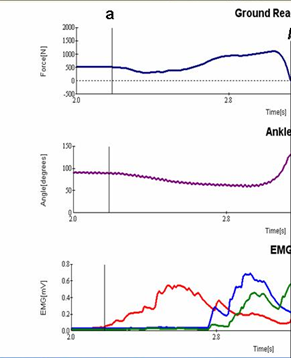
We have 3 charts:

– Force-Time Curve in blue

– Ankle-Time Curve in Purple

– Surface EMGrms activity of Tibialis anterior, soleus and gastrocnemius synchronised

The above data represent a recording of a counter movement jump. In point a the athlete is standing still and starts moving downwards flexing the knee joint, in point b the athlete has taken off, in point c, the athlete is landing.

Now, let’s look at the details:
New Picture


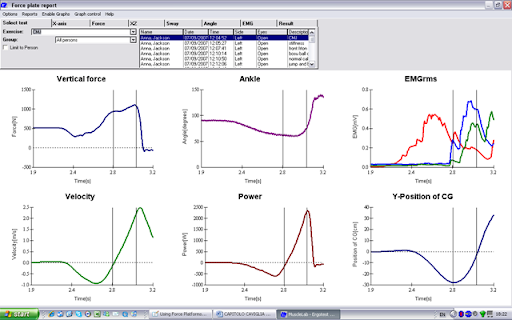
With this simple approach we can see how the peak force reaches values that are larger than 2 times the person’s body mass before take off. We can also see that the ankle contribution is limited to the last phase of take off. In terms of muscle activation patterns, tibialis anterior is very active during the downward phase of the counter movement jump, with soleus and gastrocnemius following similar patterns up until take off.

Looking at further details
image

Soleus and gastrocnemius EMGrms activity has a sharp rise in the moment of inversion of the movement, when the athlete starts to move upwards. Also, peak power output is reached way before full ankle plantarflexion is completed when taking off and also peak force is already reached.

The full movement lasts for 0.91s (from starting the movement downwards to take off).

Let’s look at the landing phase now.

image

Ground reaction force (1st graph on the left) and rate of force development (RFD) are very high, actually higher than the force necessary to take off!

Muscle activation patterns are also peculiar, at landing all muscles around the ankle joint are activated in a similar pattern, with the gastrocnemius producing a larger EMGrms activity than the soleus.

So, how do we use this information in terms of exercise prescription? We know that CMJ type of jumps are requiring a force production larger than 2 times the person’s body mass, they require a production of force that lasts less than 1 second (of course the above parameters depend a lot on the quality of the athlete tested) and the plantar flexors contribution is limited.

What about landings? As we have seen in this example RFD and Peak ground reaction force are actually higher in landing from a CMJ as compared from taking off. So, if we want to use similar exercises in an athlete that has some issues with the Achilles tendon and/or muscles of the lower leg, we can still do so, making sure he/she is not landing. The obvious suggestion is then to do CMJs jumping onto a box and/or providing a very soft surface to land on in order to reduce force production and RFD.

I hope this makes sense. More to come in the next articles!

Using Force Platforms to characterise exercises


Strength and conditioning coaches and Physiotherapists write training and rehab programs choosing various exercises. The choice of exercises depends on many aspects:

– Goals of the programme

– Movement patterns that need to be improved

– Muscle activation patterns of the chosen exercises

– Force production during the execution of the exercises

– Characteristics of the athlete/the sport/ the rehab needs for which they are writing the programme

Pretty much we can say that everyone prescribes a series of exercises for a reason, or at least, to try to obtain a specific goal. Despite this process seems pretty straight forward, it is surprising to find out how many times rehab or training programs are not based on sound progressions. Most of the times such planning mistakes are due to the fact that Force-Time patterns and/or muscle activation patterns of the exercises are unknown. This leads many times to inappropriate choice of exercise and/or inappropriate choice of progression. This problem is particularly acute when the athlete performing the training exercises prescribed is someone trying to recover from injuries.

In this simple article I want to introduce some simple concepts and some examples of how to critically analyse some exercises analysing Force-Time characteristics and muscle activation.

I promise to present more exercises in the next articles in order to provide hopefully some useful information for strength and conditioning specialists and physiotherapists.

I am going to use a simple setup for such descriptions. A Force platform measuring vertical ground reaction force, an electrogoniometer to measure angular displacement in key joints, a surface electromyography [EMG] system to measure muscle activity in key muscles. With this setup and all sensors synchronised I can analyse various exercises and provide a quantitative analysis of the forces produced, the timing of force production, the muscle activity and angular limitations.

The following is an example of data that can be obtained with such setup:

New Picture

We have 3 charts:

– Force-Time Curve in blue

– Ankle-Time Curve in Purple

– Surface EMGrms activity of Tibialis anterior, soleus and gastrocnemius synchronised

The above data represent a recording of a counter movement jump. In point a the athlete is standing still and starts moving downwards flexing the knee joint, in point b the athlete has taken off, in point c, the athlete is landing.

Now, let’s look at the details:

New Picture


With this simple approach we can see how the peak force reaches values that are larger than 2 times the person’s body mass before take off. We can also see that the ankle contribution is limited to the last phase of take off. In terms of muscle activation patterns, tibialis anterior is very active during the downward phase of the counter movement jump, with soleus and gastrocnemius following similar patterns up until take off.

Looking at further details

image

Soleus and gastrocnemius EMGrms activity has a sharp rise in the moment of inversion of the movement, when the athlete starts to move upwards. Also, peak power output is reached way before full ankle plantarflexion is completed when taking off and also peak force is already reached.

The full movement lasts for 0.91s (from starting the movement downwards to take off).

Let’s look at the landing phase now.

image

Ground reaction force (1st graph on the left) and rate of force development (RFD) are very high, actually higher than the force necessary to take off!

Muscle activation patterns are also peculiar, at landing all muscles around the ankle joint are activated in a similar pattern, with the gastrocnemius producing a larger EMGrms activity than the soleus.

So, how do we use this information in terms of exercise prescription? We know that CMJ type of jumps are requiring a force production larger than 2 times the person’s body mass, they require a production of force that lasts less than 1 second (of course the above parameters depend a lot on the quality of the athlete tested) and the plantar flexors contribution is limited.

What about landings? As we have seen in this example RFD and Peak ground reaction force are actually higher in landing from a CMJ as compared from taking off. So, if we want to use similar exercises in an athlete that has some issues with the Achilles tendon and/or muscles of the lower leg, we can still do so, making sure he/she is not landing. The obvious suggestion is then to do CMJs jumping onto a box and/or providing a very soft surface to land on in order to reduce force production and RFD.

I hope this makes sense. More to come in the next articles!

Testing team sports athletes and analysing data

Many strength and conditioning coaches and/or exercise physiologists are nowadays employed to work with team sports. Testing and monitoring training is now becoming standard practice and data analysis, data mining and the ability to produce meaningful reports is a necessary skill of the elite sports science support staff. I this short post I will not discuss the main aspects to consider when performing a test and/or the limitations of testing procedures. I will just present simple examples of reporting data using Microsoft Excel.

 Womens_Football_360x2701

When dealing with large squads, single athlete’s scores should be analysed and continuously monitored to make sure the athlete is progressing and improving. However, in order to profile areas of improvement it is important to compare the single athlete to the group or to a known group of elite performers.

A very simple way for doing this with excel is to collect all the data in a single sheet with the name of the athlete in the first column and all the tests scores in the following columns. Then, when the average values and the standard deviation for the team is calculated, all scores of each individual player can be transformed in Z-Scores. In Excel this is possible using the function STANDARDIZE which returns a normalised value from a distribution characterised by mean and standard deviation.

The syntax is the following:

STANDARDIZE(x,mean,standard_dev)

X   is the value you want to normalize.

Mean   is the arithmetic mean of the distribution.

Standard_dev   is the standard deviation of the distribution.

Once each score is normalised, spider charts can be used to see how each individual player scores as compared to the team scores. Two examples are given here. Zero is the team score, every score higher than zero means that the athlete scored better than the average value, every score below zero means that the athlete scored less than the average value.

Figure 1: This is an athlete that outscores the team average values in all tests

image

Figure 2. This is an athlete outscored team results only in sprinting.

image

When we plot the results in this way we can clearly identify areas where we need to make an impact with a training programme. So, while in athlete JL we need to put a lot of emphasis on sprinting abilities, on athlete H we need to do a lot of work on strength and power. With this approach we can then track not only athlete’s development in different areas but also how they evolve in comparison to his/her team scores. Individualization of training is the key aspect to take into consideration when working in team sports. Data analysis allows the coach, the physiologist and the sports scientist to profile each individual player and provide appropriate training interventions.