Ice and cold water after resistance exercise: are you sure it’s a good idea?

As I mentioned in a previous post on this blog I am developing an interest in recovery strategies. I am amazed of how many tools/devices/procedures/methods are nowadays used to provide a "recovery" solution to athletes.

What I am most amazed of is the total lack of rationale behind many recovery strategies, not to mention the lack of scientific evidence for their effectiveness.

It seems to me that many strength and conditioning coaches, physiotherapists, sports scientists sometimes accept some practices without really questioning why they should be using them. Unfortunately most of the times a particular recovery strategy is used just because a winning team or athlete made extensive and public use of it.

Let’s talk about Ice Baths and cold water immersion. The following picture shows what happens typically after some heavy training session these days:

Spa-ing partners: Bulldogs players take an ice bath during a recovery session at Canterbury pool. Photo: Craig Golding:Vailable at:http://www.smh.com.au/articles/2004/09/20/1095651251602.html


The reasons why athletes have to be exposed to this "torture" are the following as advocated by many S&C coaches and Physios:

  • Helps in reducing DOMS and inflammation
  • Helps in reducing swelling
  • Helps in improving blood flow
  • Helps in favouring recovery

In this article I will focus on the first point. There seems to be nowadays the need to make sure that Athletes have no DOMS (delayed onset of muscle soreness) after a training session and most of all there is a need to avoid inflammation.

With this approach, it seems that the focus of attention is now shifting away from what athletes normally do to improve performance: training!

What is training all about?

Athletes undergo gruelling training sessions to improve performance. They lift weights to get stronger, run/cycle/row to improve their endurance or speed. Simple!

The reason why they do it is to create an overload on their biological system to produce an adaptive response leading to a stronger muscle, a better cardio-respiratory system, stronger bones. They also do it to improve muscle biochemistry which then leads to better muscle function (i.e. buffering systems, metabolic enzymes).

In particular, when athletes lift heavy weights, they do it to determine muscle hypertrophy and to get stronger. The typical consequence of a weight lifting session is muscle damage then followed by an inflammatory phase and a regeneration phase able to determine a stronger muscle (for some interesting reading download this PDF of a review written by Prof. Priscilla Clarkson http://www.nmdinfo.net/Publications/Consensus%20Conf%202002%20Papers/Clarkson.pdf)

So, in simple terms, we want muscle damage, inflammation and swelling as their are the main signaling mechanisms triggering muscle remodelling (http://www.ncbi.nlm.nih.gov/pubmed/17887809?ordinalpos=7&itool=EntrezSystem2.PEntrez.Pubmed.Pubmed_ResultsPanel.Pubmed_RVDocSum).

Training-induced molecular and humoral adjustments, including muscle hyperthermia, are physiological, transient and essential for training effects (myofiber regeneration, muscle hypertrophy and improved blood supply). Stopping them may be not a good idea.

So, by reducing DOMS, swelling and inflammation are we stopping adaptations?

Maybe that’s the case. Recent studies have shown that applying cryotherapy to muscles after training reduces the training gains. Yamane et al. (2006) exposed two groups of volunteers to the same training programme and a different recovery strategy. One group was in fact asked to rest at room temperature, the other were asked to immerse the trained limbs in cold-water post training. The results showed that the group with a normal recovery improved more and the authors concluded that cooling generally attenuates the temperature-dependent processes generated by training, in particular, hyperthermia-induced HSP formation"

image

Is cryotherapy actually effective in reducing DOMS?

Science says that:Cryotherapy does not reduce DOMS symptoms (Cheung et al., Sports Med, 2003)

Cold water immersion had NO effect on perception of tenderness and strength loss (Eston & Peters, JSS, 1999)

The use of cryotherapy immediately following damaging eccentric exercise may not provide the same therapeutic benefits commonly attributed to cryotherapy following traumatic muscle injury (Paddon-Jones & Quigley ,1997 IJSM)

Recovery of muscle soreness, flexibility and power at 48 hr post-game was not significantly enhanced by performing an immediate post-game recovery beyond that achieved by performing only next day recovery training (Dawson et al., J Sci Med Sport, 2005)

Sellwood et al (2007) recently concluded that "The protocol of ice-water immersion used in their study was ineffectual in minimising markers of DOMS in untrained individuals (3 x 1min immersion in ice water). This study challenges the wide use of this intervention as a recovery strategy by athletes".

There are of course many others out there…

What can we conclude?

Using cryotherapy and cold water immersion with athletes is a very bad idea if you are training them to get stronger!

If you want to reduce pain and swelling and help with recovery in athletes performing at tournaments then you are better off with other strategies. But this is something to talk about in the next article!

MC

Ice and cold water after resistance exercise: are you sure it’s a good idea?

As I mentioned in a previous post on this blog I am developing an interest in recovery strategies. I am amazed of how many tools/devices/procedures/methods are nowadays used to provide a "recovery" solution to athletes.

What I am most amazed of is the total lack of rationale behind many recovery strategies, not to mention the lack of scientific evidence for their effectiveness.

It seems to me that many strength and conditioning coaches, physiotherapists, sports scientists sometimes accept some practices without really questioning why they should be using them. Unfortunately most of the times a particular recovery strategy is used just because a winning team or athlete made extensive and public use of it.

Let’s talk about Ice Baths and cold water immersion. The following picture shows what happens typically after some heavy training session these days:

Spa-ing partners: Bulldogs players take an ice bath during a recovery session at Canterbury pool. Photo: Craig Golding:Vailable at:http://www.smh.com.au/articles/2004/09/20/1095651251602.html


The reasons why athletes have to be exposed to this "torture" are the following as advocated by many S&C coaches and Physios:

  • Helps in reducing DOMS and inflammation
  • Helps in reducing swelling
  • Helps in improving blood flow
  • Helps in favouring recovery

In this article I will focus on the first point. There seems to be nowadays the need to make sure that Athletes have no DOMS (delayed onset of muscle soreness) after a training session and most of all there is a need to avoid inflammation.

With this approach, it seems that the focus of attention is now shifting away from what athletes normally do to improve performance: training!

What is training all about?

Athletes undergo gruelling training sessions to improve performance. They lift weights to get stronger, run/cycle/row to improve their endurance or speed. Simple!

The reason why they do it is to create an overload on their biological system to produce an adaptive response leading to a stronger muscle, a better cardio-respiratory system, stronger bones. They also do it to improve muscle biochemistry which then leads to better muscle function (i.e. buffering systems, metabolic enzymes).

In particular, when athletes lift heavy weights, they do it to determine muscle hypertrophy and to get stronger. The typical consequence of a weight lifting session is muscle damage then followed by an inflammatory phase and a regeneration phase able to determine a stronger muscle (for some interesting reading download this PDF of a review written by Prof. Priscilla Clarkson http://www.nmdinfo.net/Publications/Consensus%20Conf%202002%20Papers/Clarkson.pdf)

So, in simple terms, we want muscle damage, inflammation and swelling as their are the main signaling mechanisms triggering muscle remodelling (http://www.ncbi.nlm.nih.gov/pubmed/17887809?ordinalpos=7&itool=EntrezSystem2.PEntrez.Pubmed.Pubmed_ResultsPanel.Pubmed_RVDocSum).

Training-induced molecular and humoral adjustments, including muscle hyperthermia, are physiological, transient and essential for training effects (myofiber regeneration, muscle hypertrophy and improved blood supply). Stopping them may be not a good idea.

So, by reducing DOMS, swelling and inflammation are we stopping adaptations?

Maybe that’s the case. Recent studies have shown that applying cryotherapy to muscles after training reduces the training gains. Yamane et al. (2006) exposed two groups of volunteers to the same training programme and a different recovery strategy. One group was in fact asked to rest at room temperature, the other were asked to immerse the trained limbs in cold-water post training. The results showed that the group with a normal recovery improved more and the authors concluded that cooling generally attenuates the temperature-dependent processes generated by training, in particular, hyperthermia-induced HSP formation"

image

Is cryotherapy actually effective in reducing DOMS?

Science says that:Cryotherapy does not reduce DOMS symptoms (Cheung et al., Sports Med, 2003)

Cold water immersion had NO effect on perception of tenderness and strength loss (Eston & Peters, JSS, 1999)

The use of cryotherapy immediately following damaging eccentric exercise may not provide the same therapeutic benefits commonly attributed to cryotherapy following traumatic muscle injury (Paddon-Jones & Quigley ,1997 IJSM)

Recovery of muscle soreness, flexibility and power at 48 hr post-game was not significantly enhanced by performing an immediate post-game recovery beyond that achieved by performing only next day recovery training (Dawson et al., J Sci Med Sport, 2005)

Sellwood et al (2007) recently concluded that "The protocol of ice-water immersion used in their study was ineffectual in minimising markers of DOMS in untrained individuals (3 x 1min immersion in ice water). This study challenges the wide use of this intervention as a recovery strategy by athletes".

There are of course many others out there…

What can we conclude?

Using cryotherapy and cold water immersion with athletes is a very bad idea if you are training them to get stronger!

If you want to reduce pain and swelling and help with recovery in athletes performing at tournaments then you are better off with other strategies. But this is something to talk about in the next article!

MC
Using Force Platforms to characterise exercises


Strength and conditioning coaches and Physiotherapists write training and rehab programs choosing various exercises. The choice of exercises depends on many aspects:

– Goals of the programme

– Movement patterns that need to be improved

– Muscle activation patterns of the chosen exercises

– Force production during the execution of the exercises

– Characteristics of the athlete/the sport/ the rehab needs for which they are writing the programme

Pretty much we can say that everyone prescribes a series of exercises for a reason, or at least, to try to obtain a specific goal. Despite this process seems pretty straight forward, it is surprising to find out how many times rehab or training programs are not based on sound progressions. Most of the times such planning mistakes are due to the fact that Force-Time patterns and/or muscle activation patterns of the exercises are unknown. This leads many times to inappropriate choice of exercise and/or inappropriate choice of progression. This problem is particularly acute when the athlete performing the training exercises prescribed is someone trying to recover from injuries.

In this simple article I want to introduce some simple concepts and some examples of how to critically analyse some exercises analysing Force-Time characteristics and muscle activation.

I promise to present more exercises in the next articles in order to provide hopefully some useful information for strength and conditioning specialists and physiotherapists.

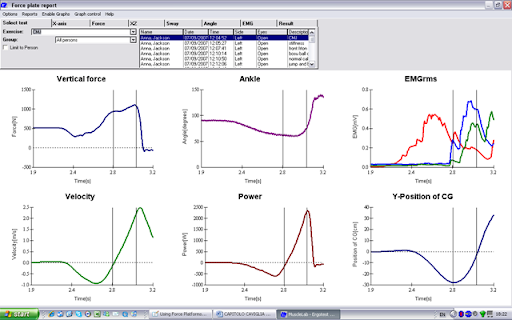
I am going to use a simple setup for such descriptions. A Force platform measuring vertical ground reaction force, an electrogoniometer to measure angular displacement in key joints, a surface electromyography [EMG] system to measure muscle activity in key muscles. With this setup and all sensors synchronised I can analyse various exercises and provide a quantitative analysis of the forces produced, the timing of force production, the muscle activity and angular limitations.

The following is an example of data that can be obtained with such setup:

New Picture

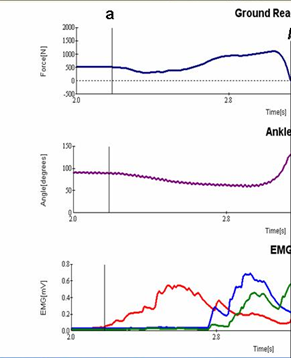
We have 3 charts:

– Force-Time Curve in blue

– Ankle-Time Curve in Purple

– Surface EMGrms activity of Tibialis anterior, soleus and gastrocnemius synchronised

The above data represent a recording of a counter movement jump. In point a the athlete is standing still and starts moving downwards flexing the knee joint, in point b the athlete has taken off, in point c, the athlete is landing.

Now, let’s look at the details:

New Picture


With this simple approach we can see how the peak force reaches values that are larger than 2 times the person’s body mass before take off. We can also see that the ankle contribution is limited to the last phase of take off. In terms of muscle activation patterns, tibialis anterior is very active during the downward phase of the counter movement jump, with soleus and gastrocnemius following similar patterns up until take off.

Looking at further details

image

Soleus and gastrocnemius EMGrms activity has a sharp rise in the moment of inversion of the movement, when the athlete starts to move upwards. Also, peak power output is reached way before full ankle plantarflexion is completed when taking off and also peak force is already reached.

The full movement lasts for 0.91s (from starting the movement downwards to take off).

Let’s look at the landing phase now.

image

Ground reaction force (1st graph on the left) and rate of force development (RFD) are very high, actually higher than the force necessary to take off!

Muscle activation patterns are also peculiar, at landing all muscles around the ankle joint are activated in a similar pattern, with the gastrocnemius producing a larger EMGrms activity than the soleus.

So, how do we use this information in terms of exercise prescription? We know that CMJ type of jumps are requiring a force production larger than 2 times the person’s body mass, they require a production of force that lasts less than 1 second (of course the above parameters depend a lot on the quality of the athlete tested) and the plantar flexors contribution is limited.

What about landings? As we have seen in this example RFD and Peak ground reaction force are actually higher in landing from a CMJ as compared from taking off. So, if we want to use similar exercises in an athlete that has some issues with the Achilles tendon and/or muscles of the lower leg, we can still do so, making sure he/she is not landing. The obvious suggestion is then to do CMJs jumping onto a box and/or providing a very soft surface to land on in order to reduce force production and RFD.

I hope this makes sense. More to come in the next articles!